
Section 1. Introducing the course: Knowledge inequity
Section outline
-
Inequity is everywhere in higher education, between countries, between regions and social and economic groups within countries. These graphs demonstrate some of the issues.
Starting with a world view:
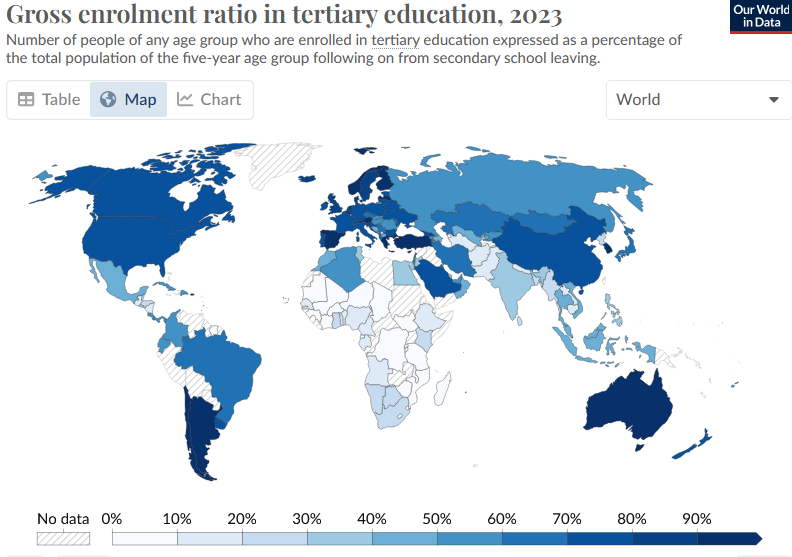
Share of the population enrolled in tertiary education, 2023. From Global Education.
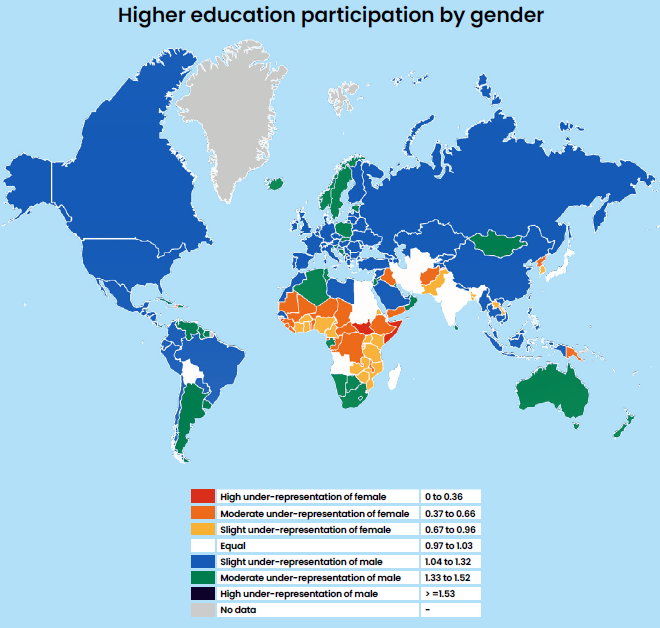
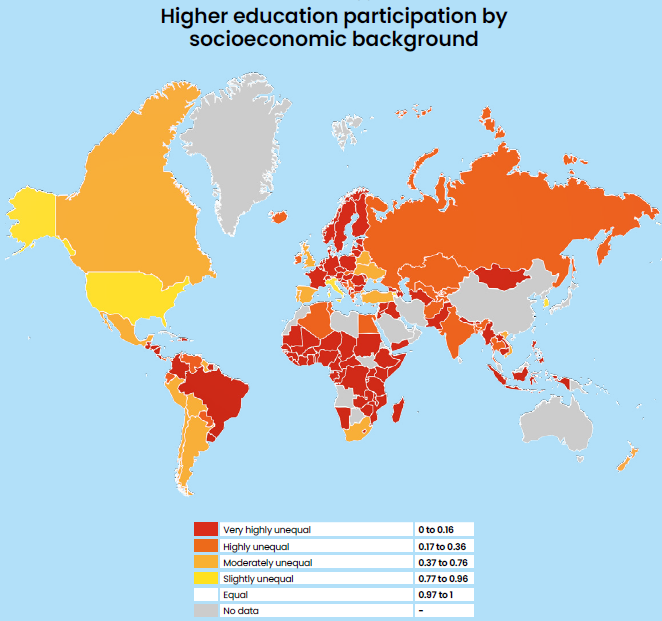
Here are two maps from the World Access to Higher Education Network showing the inequality in access by gender and socioeconomic status Drawing the Global Access Map 2: Understanding higher education inequality across the world
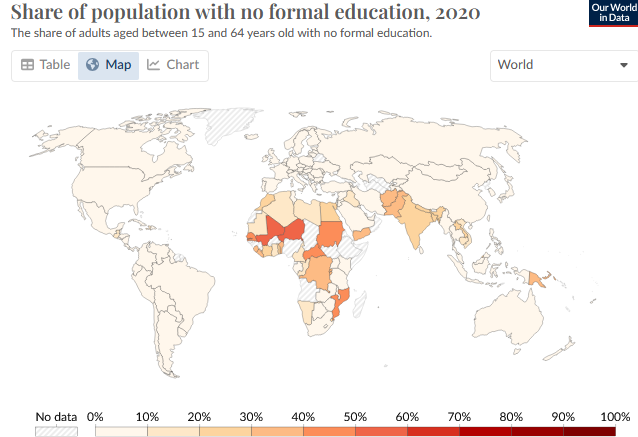
Although the main focus of this course relates to university level knowledge, of course access to tertiary education depends on having completed secondary education, and this graph, also from Global Education reminds us that there is global variation in getting any education at all
Now income disparities between and within global regions:
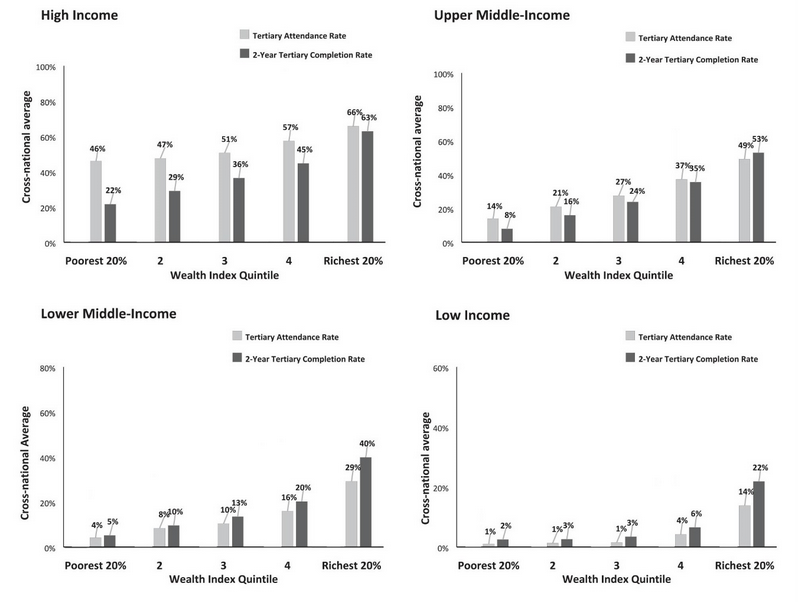
Disparities according to wealth, within and between global regions. From Buckner & Abdelaziz 2023
Political and educational consequences of educational inequality have been described for Nigeria and Kenya.
‘Differences in educational accessibility and quality between rural and urban regions, as well as between the north and the south, have contributed to social discontent, political disenfranchisement, and economic stagnation in Nigeria. In a similar vein, while there has been improvement in Kenya regarding educational access, notable inequalities still exist, especially in disadvantaged areas, which fuels political polarization and increases the economic divide.‘
Despite attempts to reduce inequity through Nigeria’s university admission policy, its limitations have been described:
‘Across the Nigerian federation, university access has increasingly come to reflect not only academic credentials but also geographical origin and socio-political identity, creating a layered admission architecture in which eligibility is governed as much by ancestral roots as by individual achievement.’
The the urban/rural divide within countries is also picked up in a number of settings:
We see social, economic and regional differences within most countries. Here are some data on the urban/rural divide from Australia:
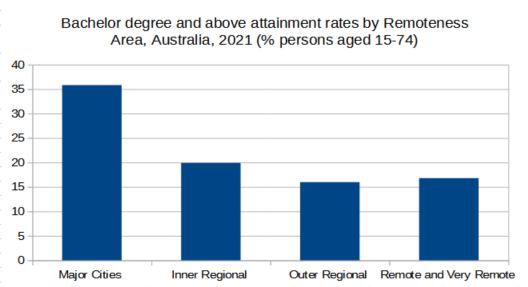
From: Parliament of Australia: Regional and remote higher education: a quick guide
You might like to explore other data that describe and explore regional variations in access to higher education where rates are invariably higher in cities than in regional and remote areas - from the UK, Australia, France, Norway, China, and Africa.
It has been reported that in Australia, somewhere between 8% and 10% of Indigenous people have a university degree, compared with 32% of the broader Australia population.
The reasons for each of these inequities are complex, and cannot be dissociated from access to primary and secondary education. However, our focus here is on tertiary, university education.
We will be covering the theory of how distributing both the learning and the creation of knowledge can help reduce knowledge inequity, and also want to provide practical skills for those who access the course. We hope that you will become practitioners of, and advocates for, this approach to higher education.-
Students mustMake forum posts: 1
Please reflect on the relevance of examples given here on inequity in access to higher education and add any examples you can offer.
-