
Establishing a mentoring programme
Section outline
-
All the information in this section of the course comes from the paper Ten simple rules for establishing a mentorship programme by Treasure et al which is an excellent guide to follow. Below the figure we list the ten rules with some of the information in the paper. But please read the whole paper - you can access it through the link, but we also recommend that you download the pdf file underneath.
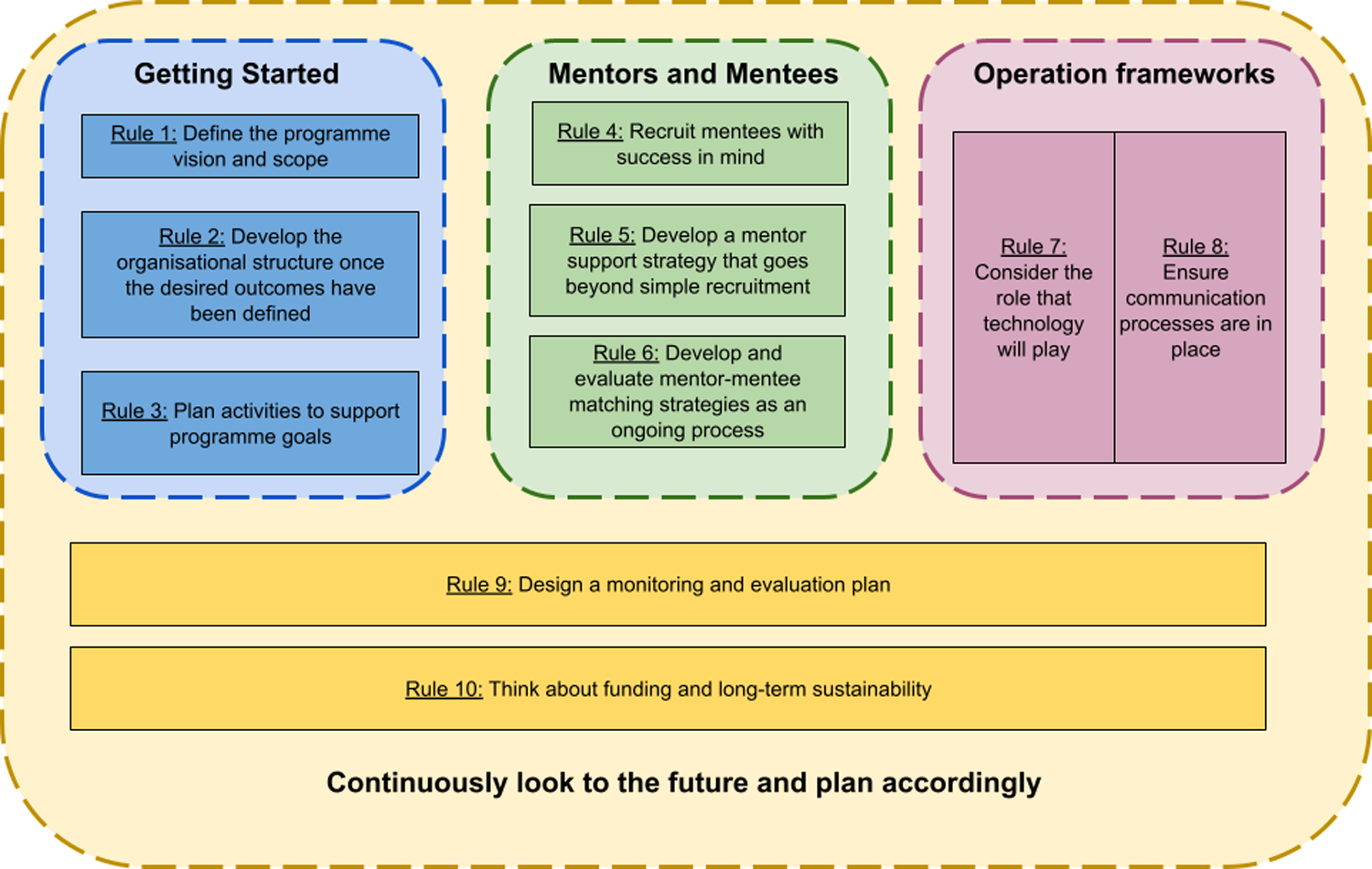 Rule 1: Define the programme vision and scope'A clear vision and well-defined scope form the foundation upon which the rest of the mentorship programme is built and influences all other rules...The most essential component in this process is the identification of the need that is being addressed...A programme’s vision and scope informs all aspects of a programme’s design, including deciding on the target audience and subject areas of focus.'
Rule 2: Develop the organisational structure once the desired outcomes have been defined
'The organisational structure of the mentorship programme is built upon the programme’s scope and outcomes...The programme’s success relies on the organisational roles being founded upon a culture of accountability and openness.'
Rule 3: Plan activities to support programme goals
'Programme support processes should be designed to enable interactions between mentors and mentees, provide equitable access to resources and aid in monitoring progress. Embedding accessibility in these processes is important to ensure benefits for everyone irrespective of differing contexts...Activities work well if the expectations that surround them are discussed at the outset. The selection and sequence of activities will depend on the target audience and the contribution of the activities towards desired outcomes. These activities could either be structured or unstructured...The CORE Africa Research Mentorship Scheme (CARMS) programme is flexible and mentors use a “what works best” approach to support mentee development. Activities range from verbal advice during one-to-one meetings or phone calls, to online and in person lectures and presentations, as well as help with documents, and supplementary learning materials being provided to mentees.'
Rule 4: Recruit mentees with success in mind
'The mentee recruitment and selection processes require careful consideration to attract and select appropriate and committed mentees...Establishing a set of entry requirements is necessary to assess a mentee’s suitability according to the programme goals...Digital privacy of all participants must be ensured and compliance with data protection laws is crucial.'
Rule 5: Develop a mentor support strategy that goes beyond simple recruitment
'When establishing a mentorship programme, it may be tempting to select mentors based solely on their experience or competency in their area of expertise. It is, however, equally important to consider mentors’ interpersonal skills, sensitivity to different mentees’ contexts and their capacity to support a mentee to be successful in the programme. In addition, mentor interest and motivation are important predictors of effective mentoring [2], and mentor commitment and programme understanding are crucial to a programme’s success...Onboarding can help to align mentors to the programme’s mission, vision, and expectations and can provide understanding of the specific needs of the mentees.support should include mindfulness of the time commitment and investment on the part of the mentors: A culture of flexibility and understanding can aid in long-term commitment and avoid mentor burnout.'
Rule 6: Develop and evaluate mentor–mentee matching strategies as an ongoing process
'Careful consideration of the initial mentor–mentee match and continuous monitoring of the match dynamics and productivity are essential to ensure effective mentor–mentee interactions.'
Rule 7: Consider the role that technology will play
'The technologies chosen will play a significant role in how participants can and will engage in the mentorship programme. Technical aspects such as access to the internet or digital infrastructure can also impact participants’ overall experience.'
Rule 8: Ensure communication processes are in place
'In any mentorship programme, communication is a crucial aspect...Although an effective strategy and pathways for communication can offer a platform to connect, experience gained through such connections can have a transformational impact beyond the programme. These communities provide opportunities for discussions and knowledge exchange within a supportive network even after the programme is over.'
Rule 9: Design a M&E plan [Monitoring and Evaluation]
'Ongoing M&E of a programme are crucial for quality improvement and for ensuring an effective mentorship programme...Decide in advance how the mentorship programme will be evaluated and how the impact of the programme will be demonstrated.'
Rule 10: Think about funding and long-term sustainability
'Some mentorship programmes may start with large-scale funding for development, whereas others start small and scale up. For the latter, starting a programme with absolutely no funding or on a shoestring budget using free resources and volunteer labour is feasible. However, financial requirements are likely to arise sooner or later in the programme as it scales.'
-
-
Students mustViewMake forum posts: 1
Reflect on which of the 10 steps described above are likely to be easy and which difficult if a mentoring programme were to be established in your setting.
-