Introducing Reflective frameworks
🧭 Frameworks of Reflection
A reflection framework is a simple, repeatable set of steps that helps you look back on an experience, make sense of it, and turn the insights into actions for next time.
Here we explore several different frameworks, as well as how we utilise these to learn through experience, adapt to change, and connect our insights to our public health practice and the WHO Essential Public Health Competencies.
“The only constant in life is change” — Heraclitus
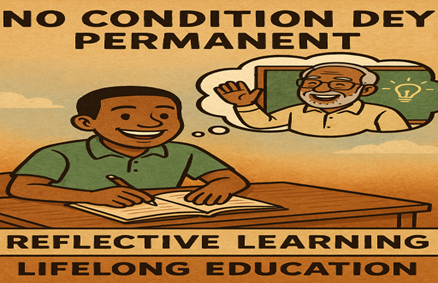
“No condition dey permanent” — West African Pidgin English proverb
A recap of why reflection matters
Reflection supports lifelong learning and helps us respond to professional, political, and social change.
Through reflection, we:
-
Keep our knowledge up to date
-
Learn from success and mistakes
-
Strengthen our adaptability and curiosity
-
Improve our judgement and teamwork
💡 Tip: Reflection is not about criticism — it’s about curiosity and improvement.
🧠 How we learn from experiences
We learn best when we:
-
Take an active role in learning
-
Connect new ideas to real situations
-
Ask what worked, what didn’t, and why
-
Apply our insights in the next action
What do we know
Reflection = thinking about our experiences to gain new understanding and improve practice.
Critical reflection = going deeper - questioning our assumptions, values, policies, and systems to learn and improve.
Ineffective vs effective reflection (a quick view)
Ineffective reflection is vague and backward-looking e.g. “that went badly” with no clear reasons, ownership, or next steps. Effective reflection is specific and forward-looking: it states what happened, why it mattered, your role, what you learned, and the concrete actions you’ll take next time, including how you’ll check if they worked.
Effective reflection is important because it turns experience into learning: you see what worked, what didn’t, and what to do next, so you improve faster and avoid repeating mistakes.
| Ineffective | Effective |
|---|---|
| Just describes what happened. | Describes and explains decisions. |
| Blames time/others; no ownership. | Surfaces assumptions, values, policy and context. |
| No lessons learned or planned. |
Includes other perspectives/evidence; states lessons learned and a specific action plan. |
3 simple steps to practice reflection
- Description — What happened?
- Analysis — Why? Feelings, decisions, other perspectives, context.
- Action — What did you learn? What will you do differently?
Next you will:
- Meet four reflection frameworks — Gibbs, Schön, Rolfe, and Triple-Loop Learning.
- Learn how to apply them to public-health scenarios.
- Decide how to choose the right one for your context.
Resources: The Resources section contains templates you can use to make reflective entries with these frameworks.