Reflection in action - a worked example
🌍 Reflection in Action: Teaching Basic Life Support in Northern Nigeria
During a short visit to a Primary Healthcare Centre in Borno State in Northern Nigeria, I was unexpectedly asked to deliver a teaching session on Basic Life Support (BLS) for a group of hospital attendants.
These attendants were often the first point of contact for sick patients, yet most had no prior medical training or exposure to formal teaching. Despite this, they were eager and motivated to learn. Though I felt unprepared, I didn't feel I could say no.
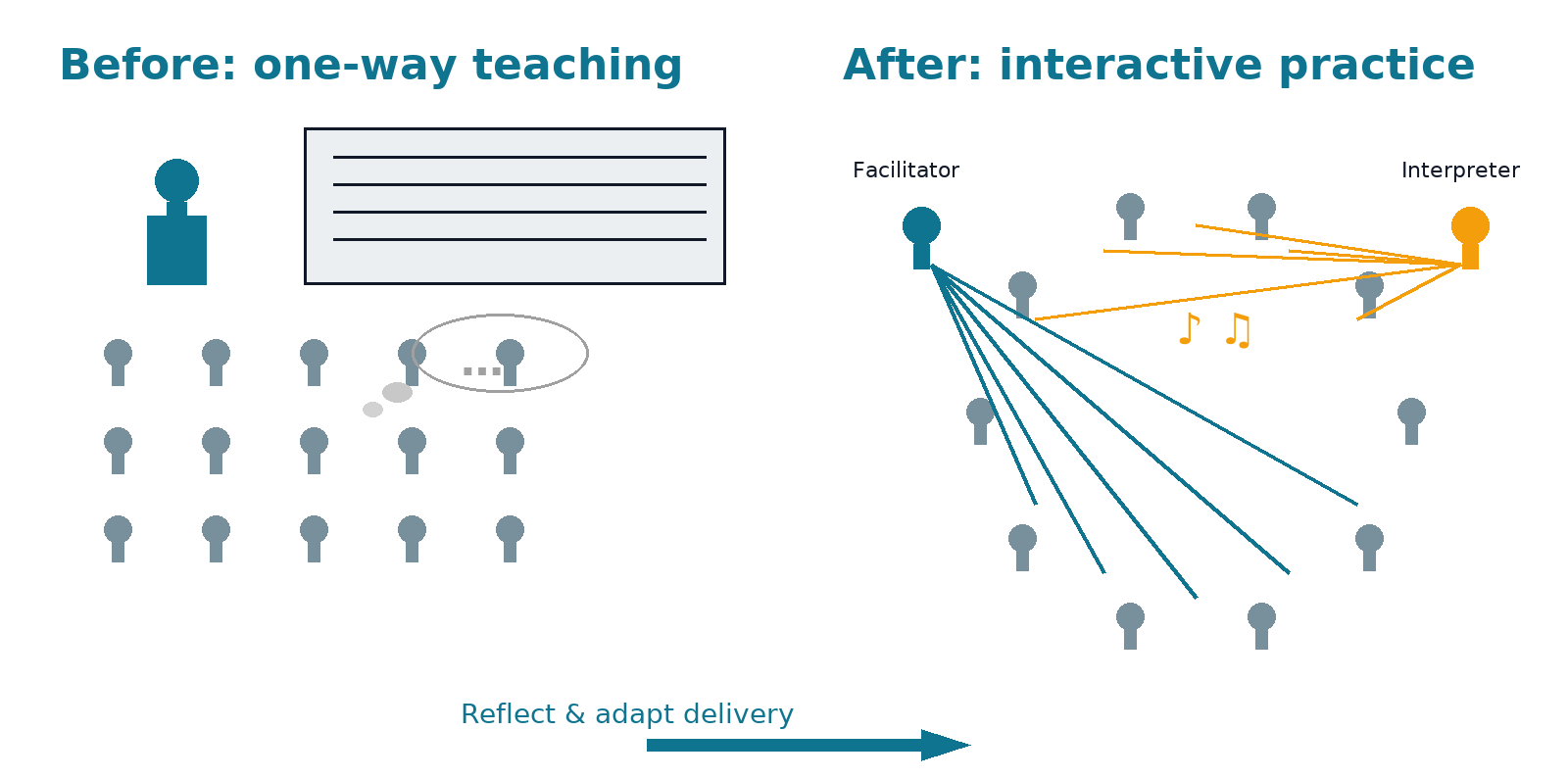
I began the session with about 15 women gathered around me, using an interpreter to explain the key stages of BLS. As I spoke, I noticed blank faces and silence – no questions, no engagement.
It became clear to me that I hadn’t presented the information in a way that was understandable, accessible, memorable, or practical for them.
With the support of a senior colleague and mentor, I quickly adapted. We transformed the session into an interactive learning experience – using demonstrations, simple language, and even creating a local song to help everyone remember the key steps.
🎶 By the end, the group was laughing, moving, and confidently recalling the sequence — turning what began as a didactic static session into one of shared learning and empowerment.
One-way teaching versus interactive
| One-way (initial approach) | Interactive (after reflection) |
|---|---|
| Long verbal explanations via interpreter | Short, clear steps in plain language |
| Minimal checks for understanding | Call-and-response and quick practice checks |
| Little movement or demonstration | Demonstrations, role-play, learners practicing |
| Low engagement and confidence | High energy; learners recalled the sequence |
| No memory aids | A simple local song as a memory aid |
Teaching basic life support at a PHC — adapting delivery after reflection.