
Introduction
الخطوط العريضة للقسم
-
Note: f you want to gain a certificate for completing this course, you will have to be given an account by the administrator or create an account through the feedback form on the site home page and log in as a student.
Health informatics, defined by the U.S. National Library of Medicine, is "the interdisciplinary study of the design, development, adoption, and application of IT-based innovations in healthcare services delivery, management, and planning". The purpose of this course is to focus on Low- to Middle-Income Countries, in order to consider how informatics can be used to help tackle some of the health problems facing populations.
The course has been informed by discussions through HIFA whose vision is "A world where every person and every health worker will have access to the healthcare information they need to protect their own health and the health of those for whom they are responsible." (Note: you can access or join HIFA for more information).
Pang et al identified a grand challenge for global public health: "to ensure that everyone in the world can have access to clean, clear, knowledge — a basic human right, and a public health need as important as access to clean, clear, water, and much more easily achievable". They go on to say: "Patients or consumers, healthcare professionals, and policymakers/managers who make up the health system must be better served by knowledge from various sources. If this is achieved, progress can be made in overcoming the seven ubiquitous health-care problems: errors and mistakes, poor quality health care, waste, unknowing variations in policy and practice, poor experience by patients, overenthusiastic adoption of interventions of low value, and failure to get new evidence into practice."
The development of the internet and its global spread provides the opportunity to increase access to knowledge, hence the field of health informatics. This course aims to provide a framework and some resources to help those in low resource settings meet knowledge needs.
Based on a review of current literature, we have structured this course in accordance with the 'Information cycle' (Note: Informatics = Information + Information Technology)
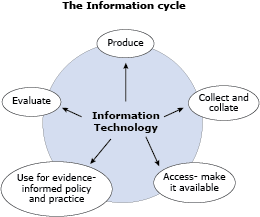
There are resources other than those we include in the sections below which you might want to explore, such as a set of free courses Health Information Systems to Improve Quality of Care in Resource-Poor Settings from MIT.
Navigating the course.
We have provided summaries of, and links to, a number of resources we think you will find interesting - to access them, click on the resources in each section, and then on the hyperlinks within each set of resources. There is also a forum in each section for reflection - you can post your reflections there if you wish.
You can gain a Certificate of Completion - the requirements for this are to access the resources and post a reflection in each section, and pass the quiz at the end.

This work is licensed under a Creative Commons Attribution 4.0 International License.