
Different Reflective Frameworks
Section outline
-
-
🔄 Gibbs’ Reflective Cycle (6 stages)
This is a step-by-step way to think about an experience.
You first describe what happened, note your feelings, judge what went well or not, analyse why, draw a conclusion about what you learned, and finish with a clear action plan for next time.
6 Stages: Description • Feelings • Evaluation • Analysis • Conclusion • Action plan.
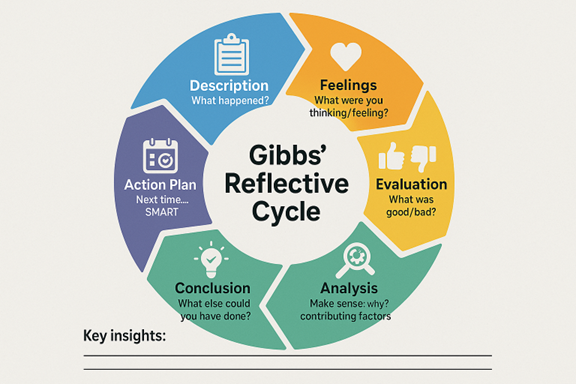
Use Gibbs when: you need a structured, step-by-step review and a clear plan.
Template available in Resources.
Source: Gibbs, G. (1988). Learning by Doing. Oxford: Further Education Unit, Oxford Polytechnic.
-
⚡ Schön’s Model — Reflection-in-action & Reflection-on-action
Reflection happens both during and after action.
Reflection-in-action means noticing what is happening and making small adjustments in the moment; reflection-on-action means looking back afterwards to understand why things went that way and how to improve.
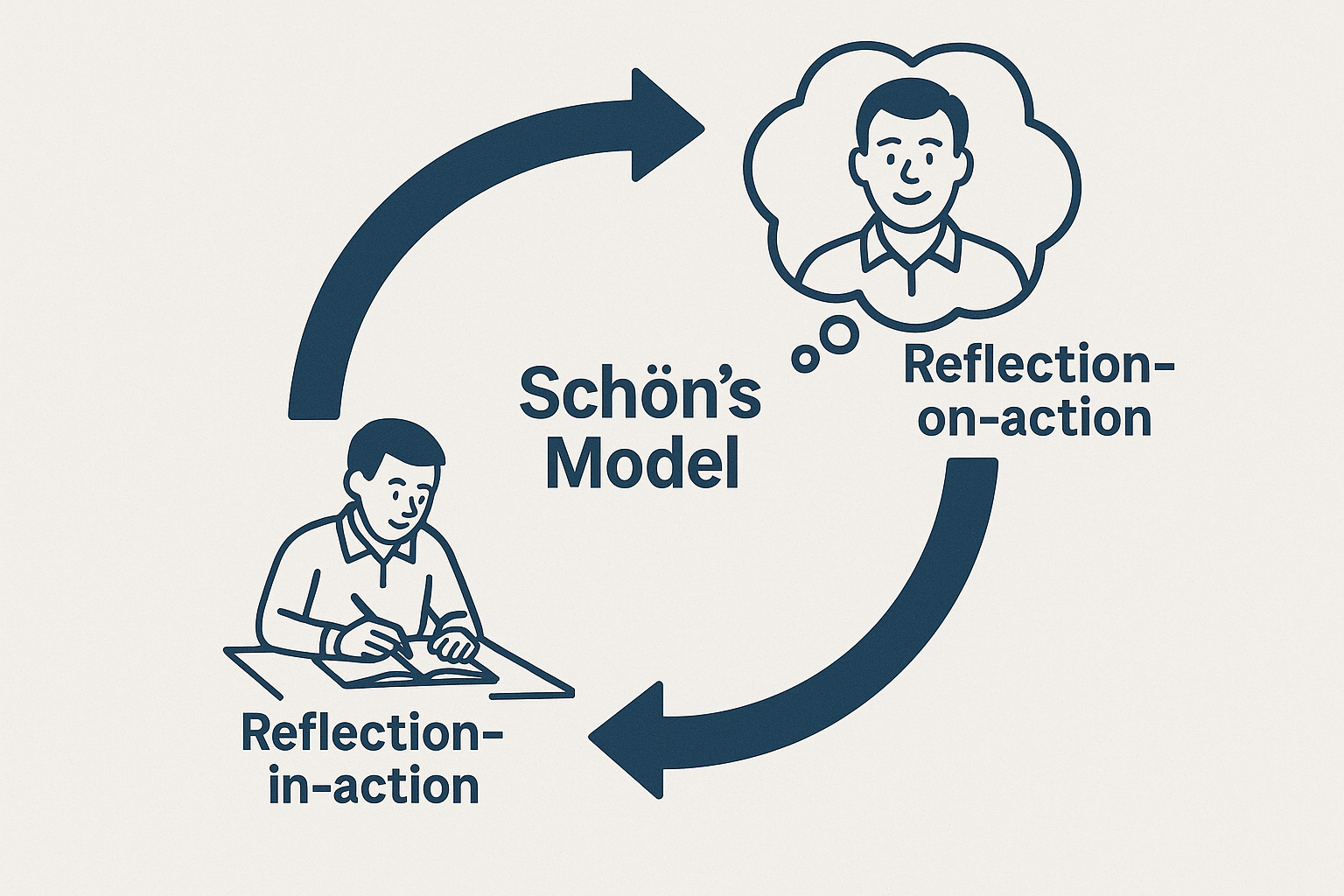
Use when: you must adapt in real time and then debrief.
Source: Schön, D. A. (1983). The Reflective Practitioner. New York: Basic Books; and (1987) Educating the Reflective Practitioner.
Template available in Resources.
-
❓ Rolfe et al. — What? • So What? • Now What?
This is a quick, practical framework built on three questions.
- What? describes the event.
- So what? explains why it matters — insights, implications, meaning.
- Now what? turns learning into next steps and changes you will make.
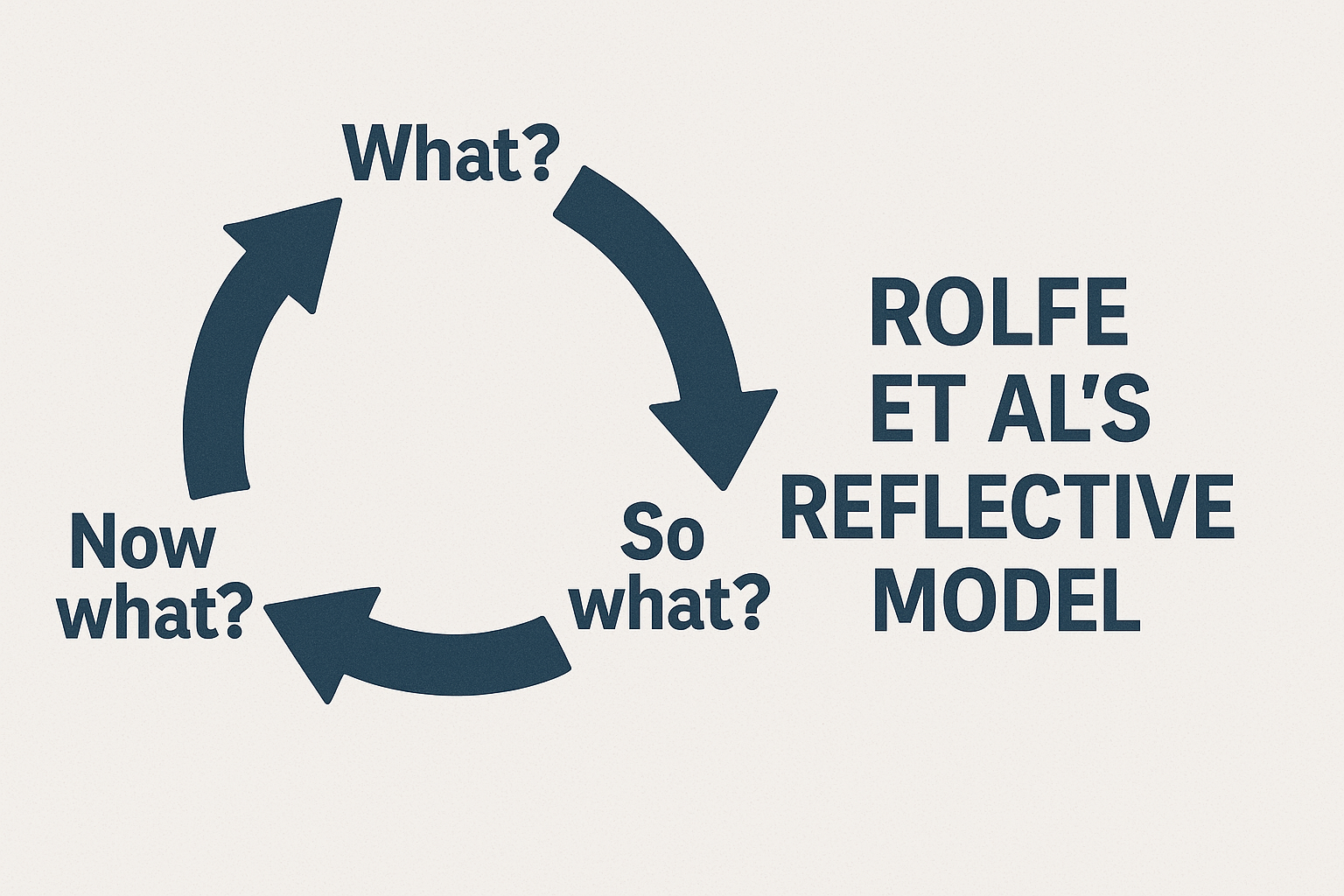
Use when: you need a fast, practical check-in.
Source: Rolfe, G., Freshwater, D., & Jasper, M. (2001). Critical Reflection for Nursing and the Helping Professions. Basingstoke: Palgrave Macmillan. (Earlier roots: Borton, T. (1970). Reach, Touch, and Teach; see also Driscoll, J. (1994)).
-
🎯 Triple-Loop Learning — Single • Double • Triple
Moves from improving tasks to reshaping thinking and decision-making.
- Single-loop: “Are we doing things right?” — tweak actions.
- Double-loop: “Are we doing the right things?” — challenge assumptions.
- Triple-loop: “How do we decide what’s right?” — examine values, power, and how ‘success’ is defined; sometimes implies changing the rules.
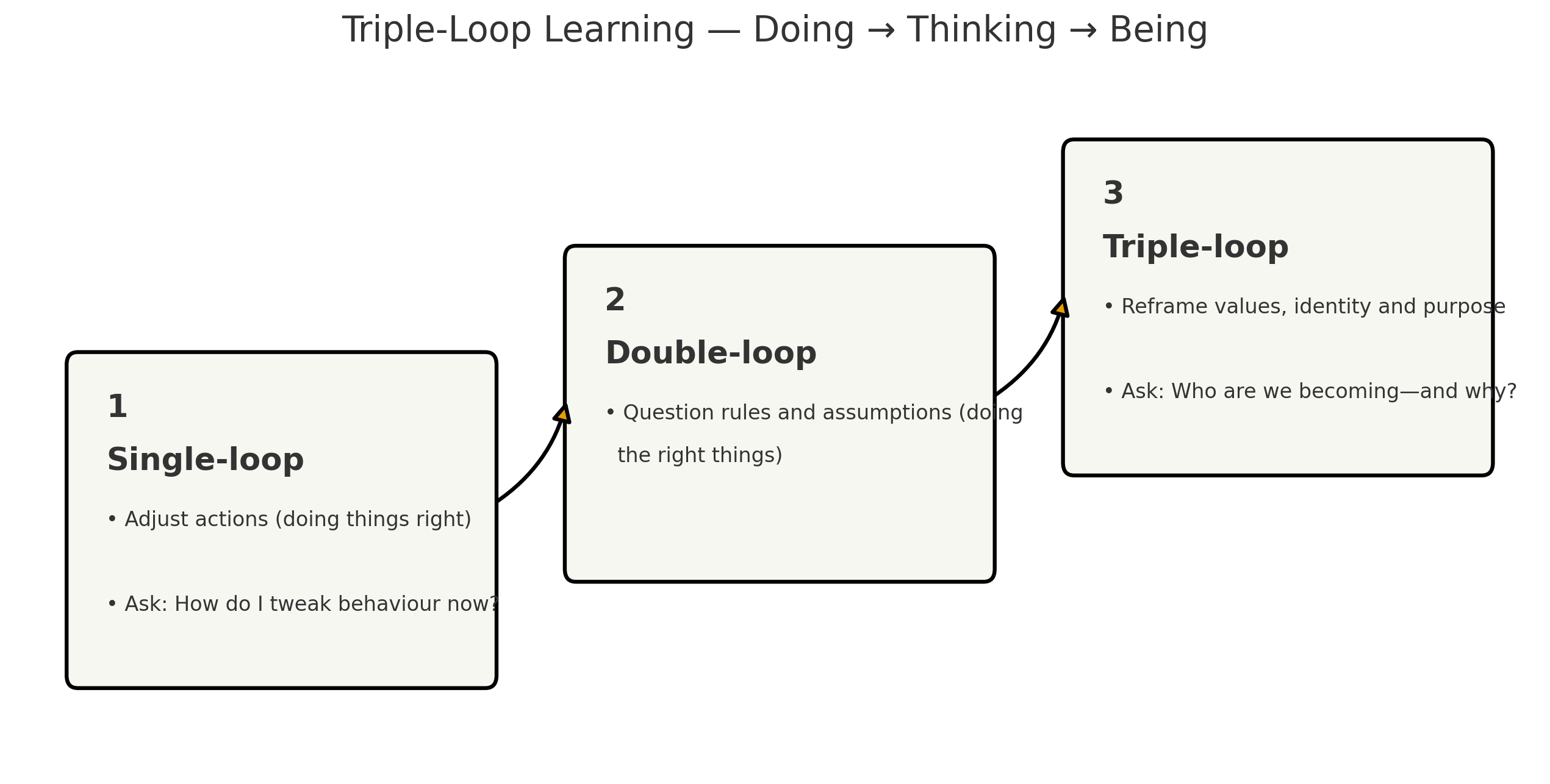
Use when: work involves policy, systems, and values (e.g., service design, governance, equity).
Source: For single/double-loop see Argyris & Schön’s organisational learning tradition; for triple-loop, see Tosey, Visser & Saunders (2012) review.
-