
Open publishing
Résumé de section
-
Commercial publishers who make large profits from academic publishing, and a number of institutional reward systems for academic publication in their journals have the result of restricting access to scientific publication by those who might find the results of use and put them into practice. The key importance of open publishing is to reduce the power of commercial publishers by opening up access in order to increase knowledge equity. This extends to opening the research process to include under-represented populations, again increasing knowledge equity (we will return to this issue elsewhere.)
Here is a nice article from the Gates Foundation: ‘Who Loses when Scientific Research is Locked behind Paywalls?’:
Journal subscriptions can cost hundreds to thousands of dollars a year for individual access and multiple millions of dollars for institutional access. Fees for publishing outside a paywall, known as article processing charges (APCs), can be as much as US$12,000 for a single article. Even the most privileged institutions struggle to afford both access to and publication in the large number of journals globally.
It’s even more frustrating because governments and foundations fund much of the world’s health-related research and journal articles are peer-reviewed by scientists for free, yet many journals continue to limit access to research findings through restrictive policies. It is small wonder that academic publishing is one of the most profitable industries in the world!A paper titled Open access research outputs receive more diverse citations summarises:
[...] we found a robust association between open access and increased diversity of citation sources by institutions, countries, subregions, regions, and fields of research [...] provides new evidence at global scale of the benefits of open access as a mechanism for widening the use of research and increasing the diversity of the communities that benefit from it.
A study performed by PublicHealth.Africa and LIBSENSE explored the open publishing practices of African journals expected to publish articles on public health. You can link to the published paper (of course it is published as open access itself) Open access publication of public health research in African journals, and here are some of the key findings:
One hundred and seventy four journals were identified from 13 African countries, 55% of the publishers were professional societies, and 52% of the journals were published only twice a year or less. While 64% were freely available to download, only 39% had a Creative Commons Licence, and only 22%, 9% and 21% were indexed in PubMed, MEDLINE or the Directory of Open Access Journals respectively, and only 58% had a Digital Object Identifier. Fifty one percent of the journals levied full Article Processing Charges – 36% of these the journals stated that these charges could be fully or partially waived.
The 6 countries above the group’s median Gross Domestic Product (GDP) published 145 journals, while the 7 countries at or below the median GP published 29 journals. Journals from countries at the median GDP or below were less likely to charge full Article Processing Charges than journals from countries above the median GDP, 28% and 55% respectively (chi-square 7.36; p=0.007).
The study concluded:
Improved opportunities are required for African researchers to publish their findings in local journals, allowing research users to access these findings.
Institutional reward systems produce barriers to open publishing
The reward system is nicely summarised in this paper The Scientific Game:
Publishing in top journals is another factor crucial for career progression, which is why many strive to do so. Publication in journals with prestigious brand names and high journal impact factors (JIFs, used as a proxy for quality), brings recognition, citations and career rewards, motivating many researchers to compete.
The paper goes on to caution about some of the dangers of the Open Access system:
If the publication is financed through article processing charges, publication volume becomes directly linked to editorial revenues and profits. This creates incentives for some publishers to maximize the number of accepted papers while saving on editorial scrutiny and peer review. In this way, Open Access can generate a perverse economy in which the argument of accessibility and public knowledge is used to extract rents from researchers, institutions, and public funding systems without contributing meaningfully to scientific quality or the cumulative stock of knowledge.
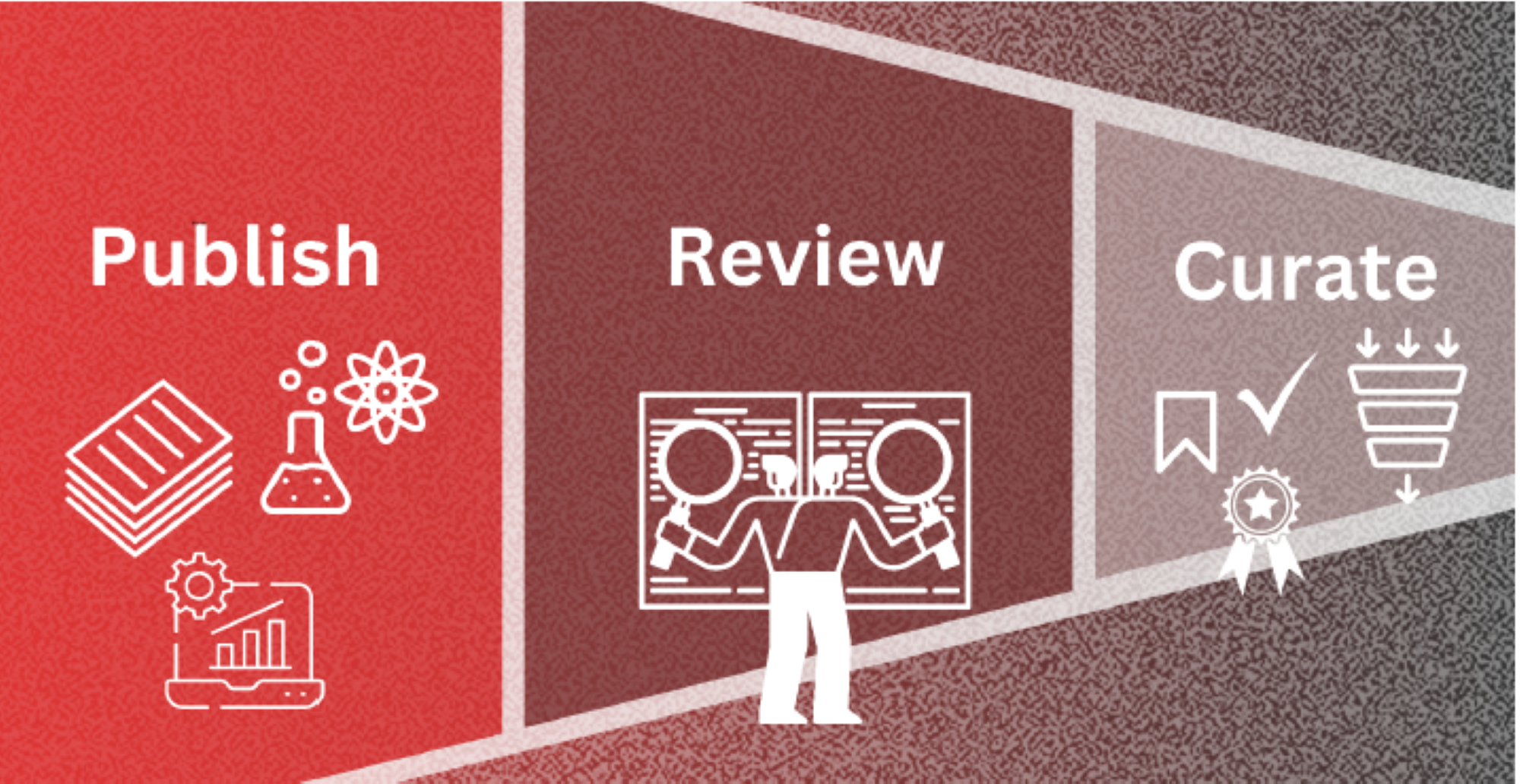
The Publish/Review/Curate model
Unlike the more traditional method where a journal will send a submitted paper for expert peer review and only publish if the reviews are positive, the model allows publication of the paper, then arrange review - and to increase transparency the reviews will also be openly published. The initial publication maybe be termed a preprint, and can be given a persistent identifier (a Digital Object Identifier, DOI, or a decentralised Archival Resource Key, ARK); this will enable indexing by various bibliographic databases, and improve discoverability by search engines, provided that the journal has been approved by those databases. Some journals will only assign a digital identifier if the review is acceptable. The usual shorthand for this model is Review-Publish.
The final step 0f the Publish-Review-Curate model is curation, which refers to a set of activities that organise and validate research outputs after they are made openly available.
Open Research Europe likes the model:
PRC introduces much greater openness and transparency in publishing by making all versions of papers, their reviews, and comments open to the public. It means research is made publicly available as soon as each output is delivered. It’s also an approach that caters to the diverse outputs that ORE welcomes. And finally, we also opt to use it because it’s researcher driven and facilitates community engagement – two important advantages for advancing open, collaborative research.
and commenting on the above post, Serhii Nazarovets agrees:
Perhaps the most important shift here is treating publication as a transparent process rather than a single final event. Making versions, reviews, and discussion visible also makes the evolution of research part of the scholarly record.
 Publish-
The Publish-Review-Curate model of publication. Corker et al., 2024, CC-BY 4.0.
Examples of open publishing
The Coalition for Open Access Publishing of Public Health in Africa (COPPHA), supported by the West and Central African Research and Education Network (WACREN). The aim is to build both capacity for peer reviewing among African Public Health researchers though online courses and the development of new open publishing options through an open repository for preprints, BAOBAB, and open reviews PublishNow.
The Diamond Open Access model of open publishing offers a major advance in open publishing:
Coalition S describes this as[…] a scholarly publication model in which journals and platforms do not charge fees to either authors or readers. Diamond Open Access journals are community-driven, academic-led, and academic-owned publishing initiatives. Serving a fine-grained variety of generally small-scale, multilingual, and multicultural scholarly communities, these journals and platforms embody the concept of bibliodiversity.
For all these reasons, Diamond Open Access journals and platforms are equitable by nature and design, and offer a preferable open access publication model.
Note: There is much more detail of open publishing in the Diamond open access book Distributing Knowledge: Openness, Equity, and Higher Education Transformation in Chapter 3: Open publishing, reviewing and curating.
You should also read about licencing copyright for open access publications - a good guide comes from Creative Commons.
There is also a comprehensive Good practice advice for OA publishing in Africa from EIFL (Electronic Information for Libraries) who have also joined a landmark statement in May 2026 to call on policymakers to remove barriers and accelerate the transition to Open Science across Europe. This statement concludes:
Achieving open science at scale will require the mobilisation of a diverse ecosystem of actors and complementary tools, including policy alignment, incentives, infrastructure, and community-led initiatives. An aligned and enabling policy environment for open science, open public infrastructures for sharing research and enhanced open science skills are key objectives pursued by EIFL through its Open Access Programme.