
Open Science (Note: this course is still under development)
Section outline
-
This site has been prepared by PublicHealth.Africa to provide resources about Open Science to the editors of journals that might publish articles on public health as well as to researchers who might want to publish their research in an open format.
Note: if you want to gain a certificate for completing this course, you will have to be given an account by the administrator or create an account through the feedback form on the site home page and log in as a student.
The objectives are for:
- All to understand the concepts, advantages and disadvantages of Open Science in relation to public health research
- Journal editors to know how to set up your journal for open publising
- Researchers to know how to submit your research paper and the underlying data so that they are freely available for open access
- All to discuss how to explore, develop and advocate for new approaches to the open publication of research and the underlying data
A definition
From UNESCO: Open science is a set of principles and practices that aim to make scientific research from all fields accessible to everyone for the benefits of scientists and society as a whole. Open science is about making sure not only that scientific knowledge is accessible but also that the production of that knowledge itself is inclusive, equitable and sustainable.
Here is a nice graphic which demonstrates many of the features of Open Science
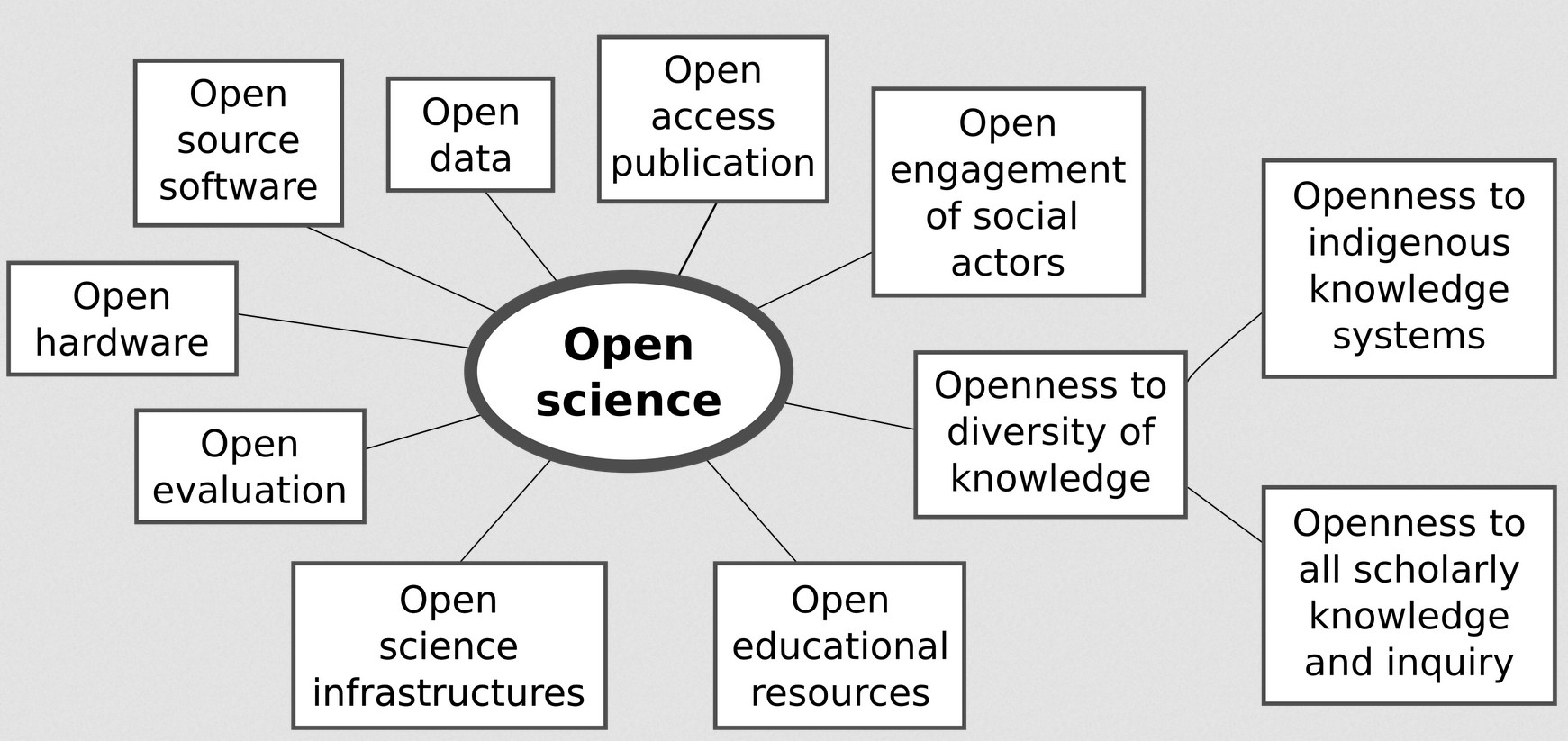
From Morrison, Wikimedia Commons, Based on the presentation by Ana Persic, Division of Science Policy and Capacity-Building, UNESCO (France) to Open Science Conference 2021. Licensed under the Creative Commons Attribution 4.0 International
In this course, we will focus on these major categories: Open scientific publications; Open research data; Open education; and Open infrastructure. We will also discuss the implications of Artificial Intelligence on Open Science, and introduce the idea of broadening the concept of Open Science from Access to include Distribution - designed to reduce the barriers to the implementation of Open Science.
Open Science and knowledge equity
Openness is a key component of how to distribute both access to knowledge and its production equitably. This is discussed in detail in the open access book Distributing Knowledge: Openness, Equity, and Higher Education Transformation.
How to navigate the course
Each section comprises a set of resources that we think you will find interesting - click on the collections of resources in each section. There is a forum in each topic for reflection.
We encourage you to reflect on what you have learned or comment on the course. When you click on the hyperlink in each topic labelled reflection, you will be able to add a new topic or respond to a previous one. You may want to share your learning from this and other readings, comment on the topics from your own experience, comment on others' posts, or provide feedback on how we can improve the content and presentation.
In the final section you will see that you can gain a Certificate of Completion - the requirements for this are to post a reflection in each section (however, you must enrol as a student first).

This work is licensed under a Creative Commons Attribution 4.0 International License.